The O's woes
The 1988 Baltimore Orioles got off to the worst start in major league history

Have you heard the one about…
…the worst start in major league history?
NOTE: This story is adapted from a piece I wrote for my old View From the Bleachers Substack in 2024.
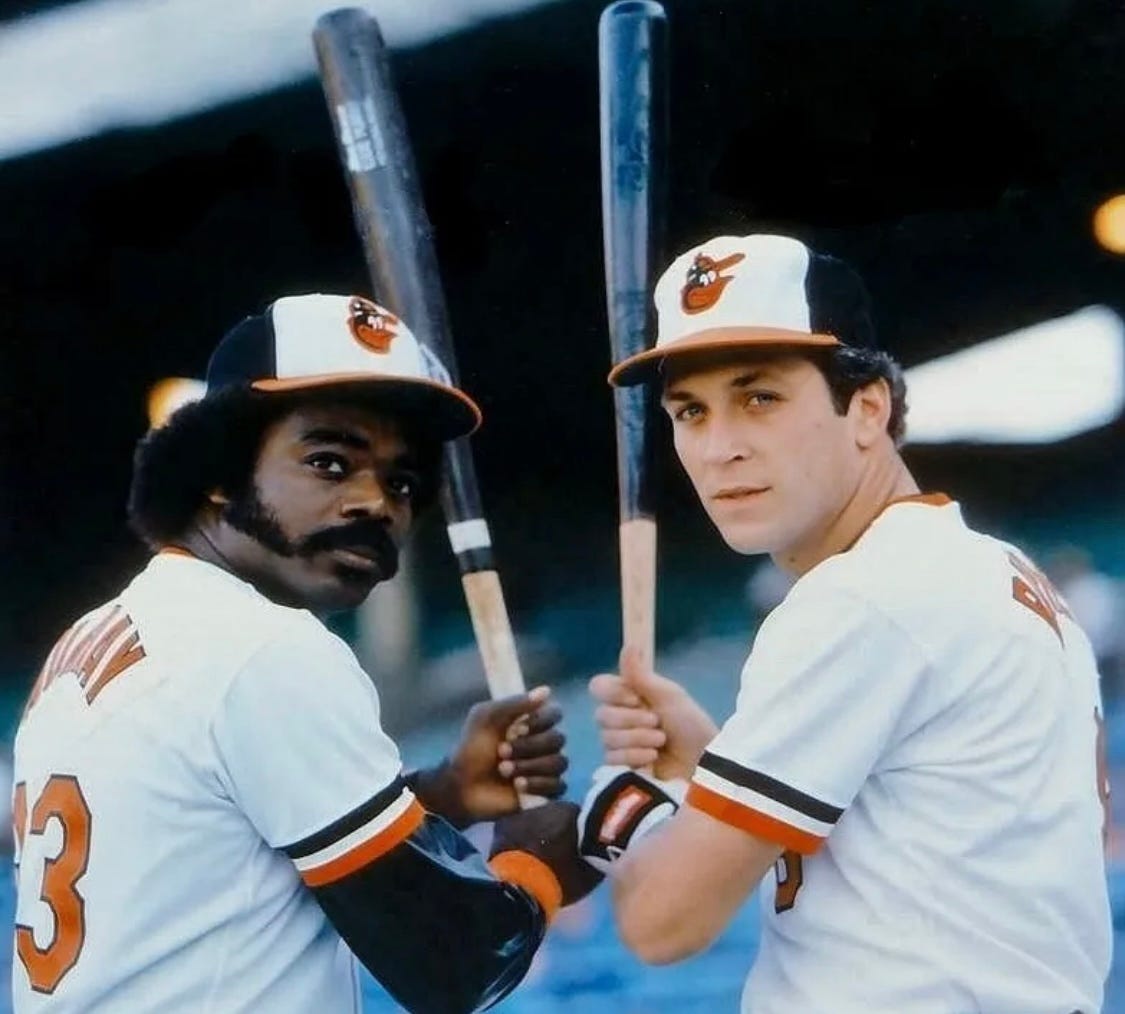
Just 5 years removed from winning a World Series, expectations weren’t high for the 1988 Baltimore Orioles. They were coming off a 95-loss season during which they dropped 30 of their final 41 games. Even though the roster had been turned over--with only 11 players from Opening Day ‘87 on the 24-man squad that began ‘88--most anticipated a challenging season, even with a lineup anchored by future Hall of Famers Cal Ripken Jr. and Eddie Murray.
Still, no one could have foreseen what the opening weeks of 1988 held in store.
No team in history had ever gotten off to a worse start than that Baltimore club, which face-planted out of the gate with 21 consecutive losses.
How bad was it? Maybe the die was cast prior to the start of Spring Training.
In those years, the Orioles had a basketball team that spent part of the winter traveling around Maryland playing games to raise money for local charities. Cal and Billy Ripken, Mike Boddicker, Larry Sheets and Jim Traber were among the players who laced up their high tops.
So was projected ‘88 O’s center fielder Ken Gerhart, at least until he suffered an ankle injury on the hardwood, and was forced to open the season on the disabled list. To make matters worse, he was accidentally placed on the 21-day DL instead of the 15-day DL, which cost him an extra week’s worth of games in April even after he was ready to return.
While that seems like it may have been a bad omen, the Gerhart injury was the least of the 1988 Orioles’ problems once the season began.
Playing in front of 52,395 at Memorial Stadium, to this day the largest regular season crowd in club history, the O’s were blasted 12-0 by the Brewers on Opening Day.
The O’s were outscored 30-2 in losing their first 4 games.
After starting 0-5, reliever Tom Niedenfuer told the Washington Post, “Every team in the majors is going to lose 5 games in a row at some point. Ours are just coming at the beginning.”
But the beating went on. And on.
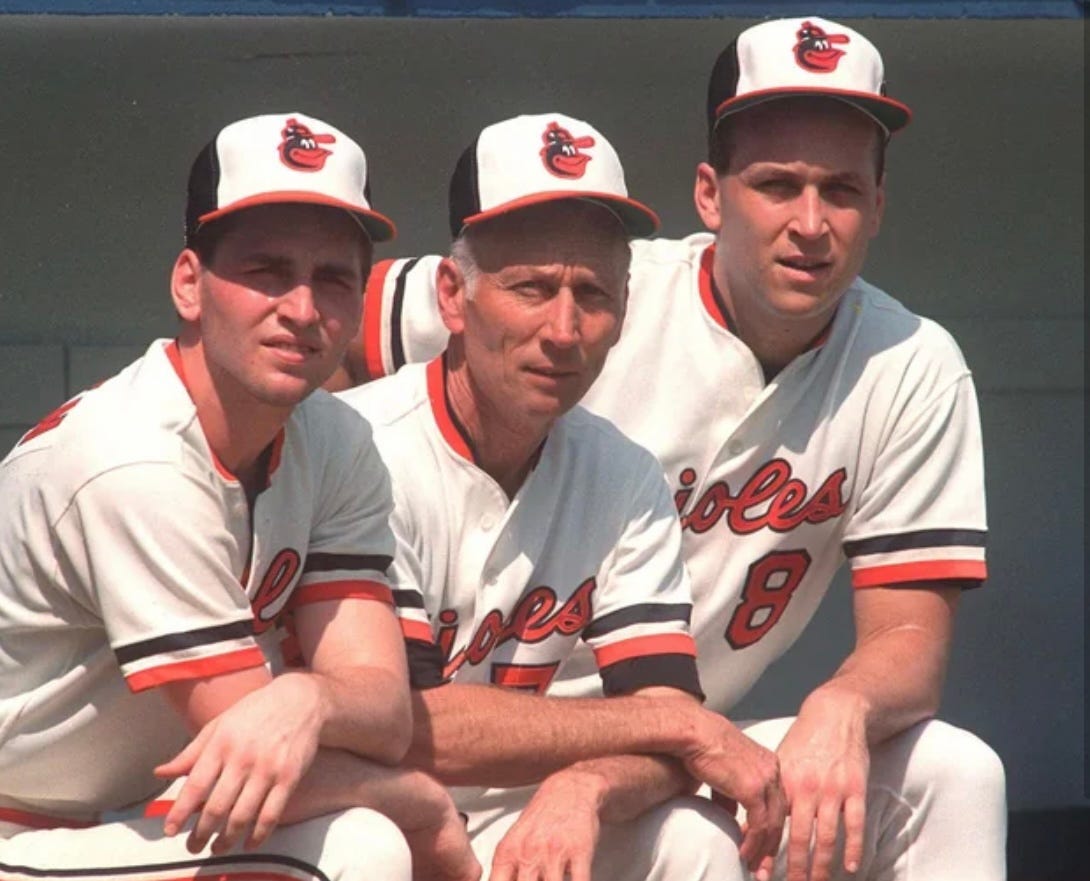
The club fired manager Cal Ripken Sr. after starting 0-6. A member of the organization since 1957 and the father of the team’s star shortstop (Cal Jr.) and starting second baseman (Billy), Cal Sr. was replaced by Frank Robinson, who had been working in the club’s front office. Robinson would lose his first 15 in a row after moving downstairs.
There were some close calls along the way, including 5 one-run losses. The Orioles dropped 3 games in a row by a single run in losses 9-11.
In loss #9, the O’s blew 2 sacrifice bunt attempts, committed 3 errors and were called for 2 balks in a 4-3 setback against Kansas City. The next night, a 76-minute rain delay was the highlight of a 3-2 loss to the Indians as the streak hit double digits. Game 11 was a 1-0 loss to Cleveland in 11 innings. After O’s starter Mike Morgan worked 9 innings of 2-hit shutout ball, Dave Schmidt pitched a scoreless 10th before allowing the only run of the game on a 2-out RBI single by Willie Upshaw in the top of the 11th. Cleveland starter Greg Swindell worked 10 innings-plus. Down 1-0 in the last of the 11th, the O’s had runners at 2nd and 3rd with one out, but Cal Ripken Jr. lined out to pitcher Doug Jones. After Sheets was intentionally walked to load the bases, Jones caught Terry Kennedy looking at strike 3 to extend the Orioles’ misery on a night on which they went 0-for-12 with runners in scoring position.
In game 12, they broke out their orange jerseys for only the 3rd time in 5 years, but fell 4-1 to Cleveland. Through 12 games, they had scored a total of 17 runs.
With their 9-5 loss in Milwaukee in game 13, they tied the 1904 Washington Senators and the 1920 Detroit Tigers for the longest season-opening losing streak in ML history. They grabbed sole possession of the mark the following night, losing 8-6 to the Brewers at County Stadium.
By that time, a large contingent of national media had begun following the Orioles on a daily basis. Night after night, they asked struggling players questions they simply couldn’t answer.
Loss #15, a 7-1 setback against Chris Bosio and the Brewers, gave the Orioles the longest losing streak in franchise history.
A 9-run first inning--in which O’s starter Mike Morgan allowed 6 runs on 6 hits without recording an out--carried the Royals to a 13-1 win in game #16.
The next day Kansas City squeaked out a 4-3 win, scoring 2 runs on balls lost in the sun. Still, the game was tied 3-3 in the bottom of the 9th. With one out, Bo Jackson hit what looked like a routine fly ball to left field off Doug Sisk, but the wind took hold of the ball and pushed it toward the outfield wall. Just into the game defensively after pinch hitting in the previous half inning, O’s left fielder Jeff Stone crashed into the fence, unable to make the play, as Jackson sped into third base with a triple. Following an intentional walk to pinch hitter Thad Bosley, Kurt Stilwell lined a single into shallow center field, and the Orioles had been walked off on their way to 0-17.
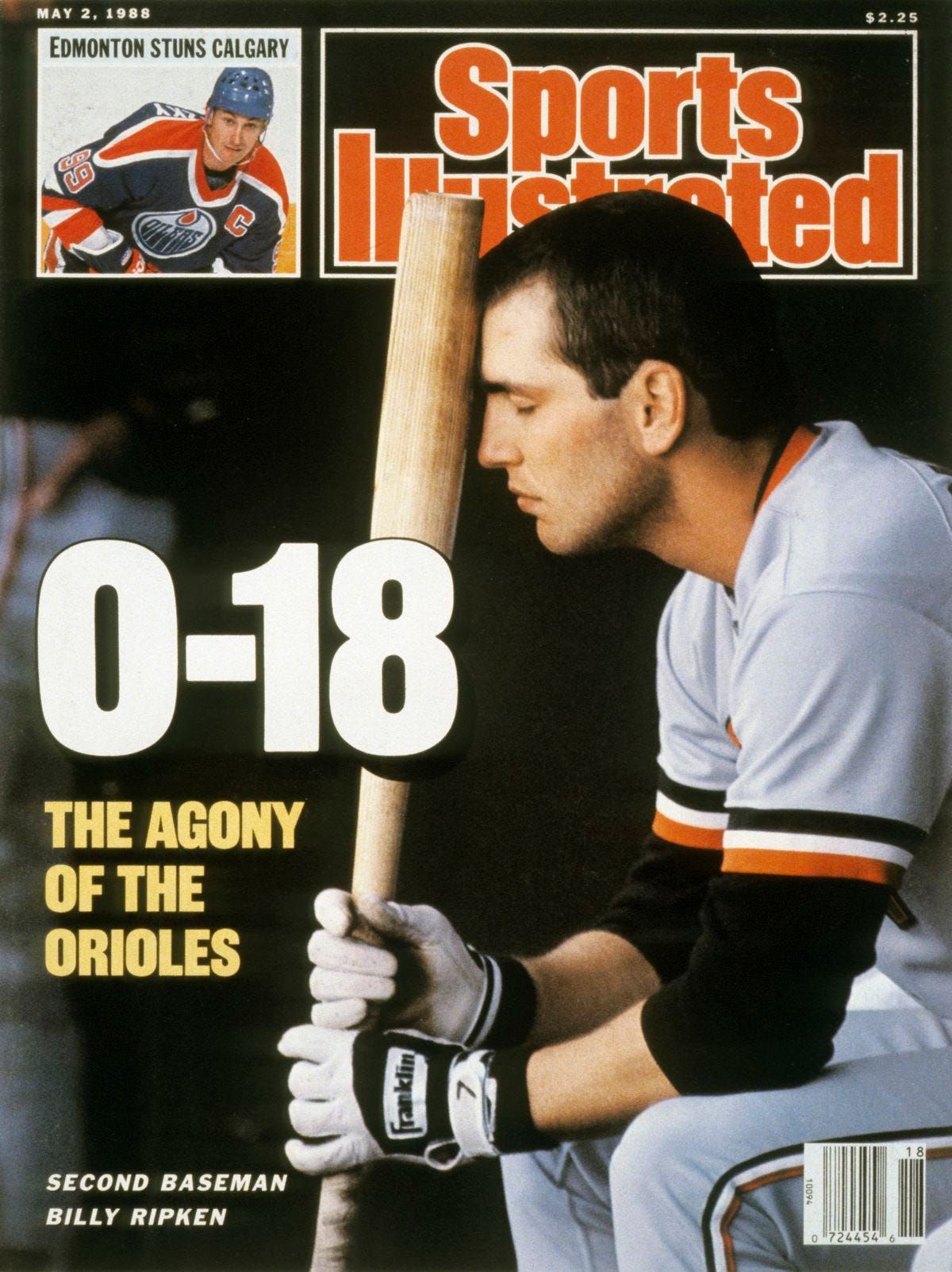
A Sunday afternoon 3-1 Royals win wrapped up a series sweep and dropped the O’s to 0-18, earning them a spot on the cover of Sports Illustrated. This time, however, there may not have been an SI cover jinx. Win #1 was only 4 games away.
President Ronald Reagan called Robinson to offer his support before a 4-2 loss to the Twins dropped the Birds to 0-19.
A 9th-inning rally came up short in loss #20 in a row, 7-6 in Minnesota. That loss matched the 1906 Red Sox and the 1916 and 1943 Philadelphia Athletics for the longest losing streak in AL history.
They broke the record the following day at the Metrodome in a 4-2 loss despite GM Roland Hemond breaking out the same gray suit he had worn during a 1983 champagne celebration during happier times with the White Sox. At 0-21, the Orioles were 16 games behind the first-place Indians in the AL East.
It was only April 28.
According to Baltimore Sun accounts, the misery wasn’t confined to the field. On the night of April 12, during a 6-1 loss to the Royals in game 7 of the skid, “A bizarre incident happened in the parking lot at Memorial Stadium…Someone left a dog in his car. The dog jumped around, putting the car in gear. It rolled into 2 other cars, causing major damage.”
2 nights later, after a 4-3 loss to the Royals dropped the O’s to 0-9, the Sun reported that “general manager Roland Hemond, farm director Doug Melvin, and 7 others were trapped in an elevator at Memorial Stadium for 73 minutes. The Orioles had planned to make a roster move after (that) night’s game, but it had to be delayed until (the next day) because Hemond was trapped.”
An SB Nation retrospective on the O’s 0-21 start tells the story of Baltimore DJ Bob Rivers of WIYY Radio encouraging listeners to drive with their headlights on to show their support for the beleaguered hometown team. After the club’s 11th loss to open the year, Rivers vowed to stay on the air non-stop until the Orioles won a game. He slept 2 hours a night in the studio and became a regular correspondent on the Arsenio Hall Show, reporting nightly on Baltimore’s baseball nightmare.
Outfielder Larry Sheets shaved his mustache, in hopes of changing the team’s luck. Multiple players refused to change their underwear. And Ken Gerhart decorated his locker with roses in search of “the smell of victory.”
Swept in each of their first 7 series, those O’s hit .200 with a .266 OBP, a .282 slugging percentage and a .549 OPS during their historic season-opening slide. Their pitching staff posted a 5.96 ERA in the 21 games.
They were outscored 129-44.
With losses in their first 21, the Orioles were only 2 losses shy of equaling the longest losing streak at any point in a season in modern ML history, a 23-gamer by the Phillies in July and August of 1961.
But, alas, it wasn’t to be.
A sophomore at Northwestern, I was in the first-base grandstand at old Comiskey Park on the South Side of Chicago on Friday night, April 29 when the O’s finally broke through.
Facing rookie righthander Jack McDowell, who would go on to earn 3 All-Star selections and win a Cy Young Award, Cal Ripken hit a 2-out single in the top of the first, and Murray followed with a 2-run homer to right. Ripken would go deep himself later in the game en route to a 4-for-5 night with 3 runs scored, and the O’s coasted to a 9-0 victory.
Mark Williamson and Dave Schmidt combined on a 4-hit shutout.
Years later, then Orioles broadcaster Jon Miller recalled that there was no great celebration on the field after the final out, future Hall of Famer (and Baltimore native) Harold Baines’ ground ball to second baseman Pete Stanicek.
Miller compared the finally victorious O’s to survivors of the Titanic.
“There were the survivors being taken out of the lifeboats, on to the Carpathia, the ship that came to rescue them. They were distressed, and they were not thrilled, perhaps, about being saved, even. They were just survivors.”
—Hall of Fame broadcaster Jon Miller
Win #1 did little to reverse the Orioles’ fortunes. A loss on April 30 dropped them to 1-22, giving them the worst record in any single calendar month of any team in ML history.
After their 0-21 start, the O’s went 54-86 the rest of the season--worst in the American League over that span.
At 54-107, they finished 34 1/2 games behind the AL East champion Red Sox. It was the O’s first 100-loss season since 1954, the year the St. Louis Browns moved to Baltimore and became the Orioles.
The ‘88 O’s scored the fewest runs in MLB (550) and allowed the most (789), posting a staggering -239 run differential.
They didn’t win consecutive games until they strung together 3 victories in a row May 21-23 in games 41-43. That was one of only 11 instances all season in which the O’s won 2 or more in a row. They won a season-best 4 consecutive contests August 2-5. But they ended the season by dropping 17 of their final 20.
Cal Ripken Jr. (.264/.803 OPS, 25 2B, 1 3B, 23 HR, 81 RBI) would be the Orioles’ lone All-Star, as he and Murray (.284/.836 OPS, 27 2B, 2 3B, 28 HR, 84 RBI) had solid but--by their standards--unspectacular seasons.
Fred Lynn added 18 home runs, while no other 1988 Oriole hit more than Mickey Tettleton’s 11.
Sheets, who eventually grew his mustache back, was the top RBI man on the club outside of Murray and Ripken with 47.
Schmidt and Jeff Ballard led the pitching staff with 8 wins apiece.
Following the 1988 season, the Orioles traded 32-year-old franchise icon Eddie Murray to the Dodgers, citing a need to get younger, to add speed and aggressiveness.
In a departure from the previous year, the ‘89 O’s actually opened the season with consecutive home wins over the Red Sox, yet they found themselves 3 games under .500 at 18-21 in late May, approaching the 1/4 mark of the season. But the O’s then rattled off 13 wins in 14 games and, having adopted the “Why Not?” mantra, went 68-54 from May 22 through the end of the season.
The Orioles headed into a season-ending series with the Blue Jays just one game behind first-place Toronto in the AL East. A Baltimore sweep would have won the division, and wins in 2 of 3 would have forced a one-game playoff for the division crown.
The Jays spoiled the fun, however, taking the first 2 games of the series. Still, the Orioles went from 54 wins in 1988 to an 87-75 record one year later, finishing 2nd in the East in the pre-Wild Card era.
The Orioles fell just short of the playoffs in 1989, but with a 33-win improvement, the misery of 0-21 was a distant memory.
While You’re Here…
Your feedback is always appreciated. Hit the “LIKE” button below if you enjoyed this post and please leave a comment.
Have a topic you’d like to see me write about in future editions of Extra Innings? Tweet me @GlennGeffner and use hashtag #ExtraInnings.
Learn more about one-on-one play-by-play coaching from Glenn Geffner via Zoom at GlennGeffner.com.
If you enjoy baseball stories like this one, there are plenty more to come.
Extra Innings explores strange, fascinating and often forgotten occurrences from baseball’s past--stories that live beyond the boxscore. With a subscription, new stories will be delivered directly to your email three times each week, with one free post every Monday (at least to get started) and subscriber-only stories every Wednesday and Friday.
If you’d like to join our Extra Innings community, I hope you’ll consider subscribing. A monthly subscription is only $8. You can purchase an annual subscription that covers the 2026 season and occasional off-season posts for $80.
And if you enjoy our content, please share it with others who share our passion for baseball.