
The Giants' slayer
For all he accomplished on his way to the Hall of Fame, Carl Hubbell will always be remembered best for five strikeouts

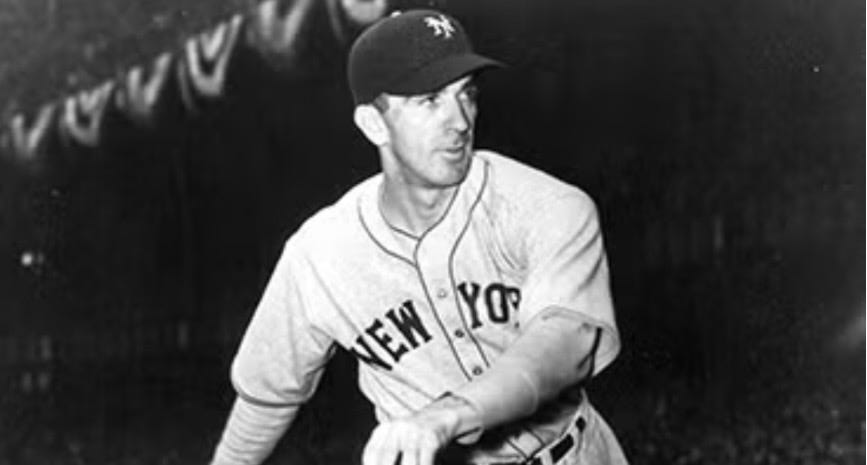
Have you heard the one about…
…King Carl’s strikeouts?
Ty Cobb thought it was a mistake.
That alone should have been enough.
When one of the greatest players in baseball history tells a young pitcher to change something, most would suggest you ought to listen. Cobb had won 12 batting titles. He had accumulated more than 4,000 hits. By the time Carl Hubbell briefly passed through the Detroit Tigers organization in the 1920s, Cobb had forgotten more about baseball than most players would ever know.
His advice to the skinny lefthander from Oklahoma was simple.
Forget the screwball. Throw something else.
Fortunately for Hubbell, he didn’t listen.
Because less than a decade later, on one unforgettable July afternoon in New York, that strange, twisting pitch would do something no fastball or curve ever could.
It would make Babe Ruth look helpless.
Then Lou Gehrig.
Then Jimmie Foxx.
Then Al Simmons.
Then Joe Cronin.
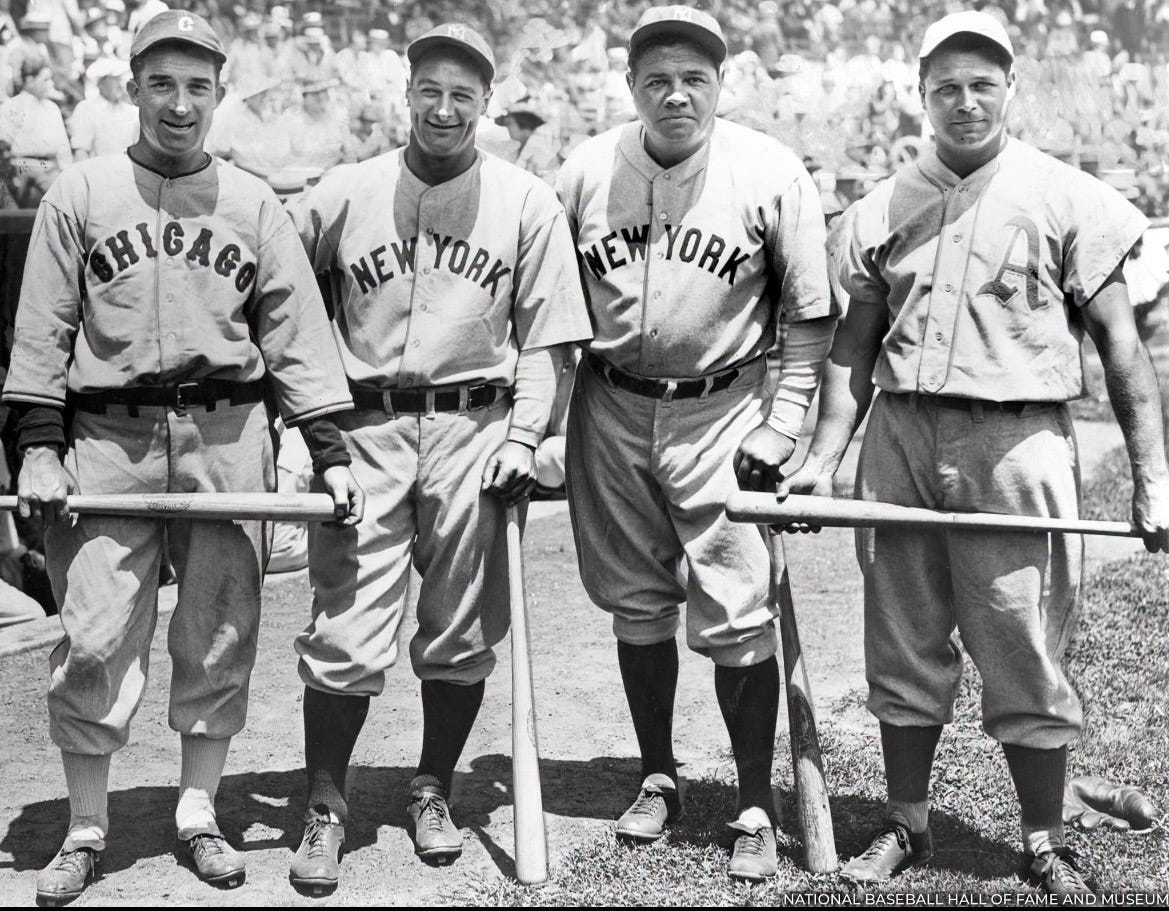
Those five names have become the answer to one of baseball’s favorite trivia questions, repeated almost like a nursery rhyme by generations of fans.
Which five Hall of Famers did Carl Hubbell strike out in succession in the 1934 All-Star Game?
Ruth.
Gehrig.
Foxx.
Simmons.
Cronin.
The feat has become so famous that, for many, it defines Hubbell's career.
And that’s unfortunate because the greatest pitching performance in All-Star Game history wasn’t simply about five strikeouts. It was about a quiet Oklahoma farm boy who trusted the one pitch many along the way had wanted him to abandon.
And on one afternoon, against one of the greatest lineups ever assembled, he proved them all wrong.
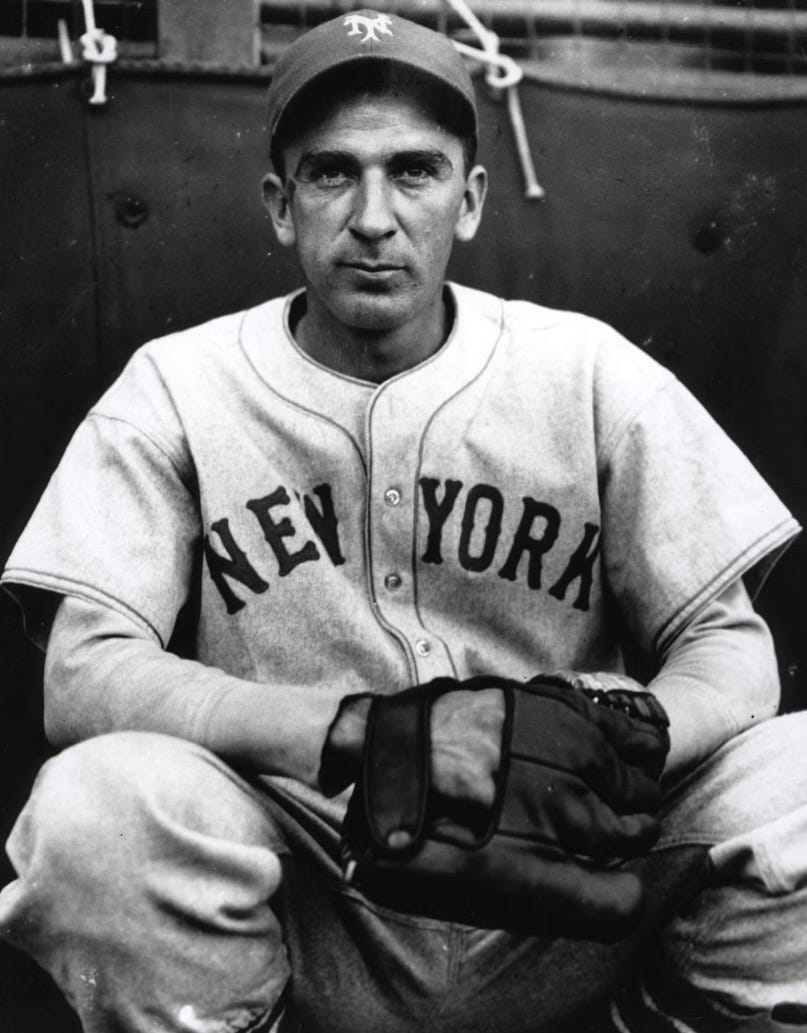
Carl Hubbell didn’t look like a man destined to become a legend.
He wasn’t imposing. He didn’t intimidate hitters with blazing fastballs. He didn’t swagger around the mound or cultivate the larger-than-life personality that defined so many stars of the era.
He was listed at 6-foot, 170 pounds. Friends described him as soft-spoken and modest. He preferred talking about hunting and fishing to talking about baseball. He grew up on a farm near the tiny central Oklahoma town of Meeker, which had a population of about 500 at the time. In Meeker, chores came before recreation, and no one imagined one of their own would someday go toe-to-toe with Babe Ruth and come out on top.
Hubbell’s greatest weapon wasn’t something he invented.
It was something he never gave up.
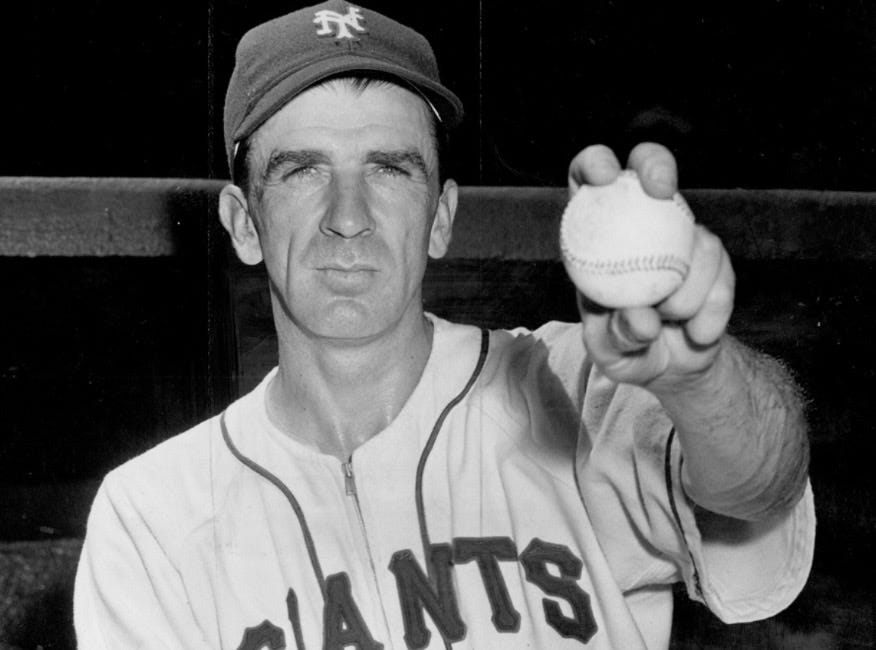
Nobody knows exactly how many screwballs had been thrown before Carl Hubbell reached the major leagues, but no one had ever mastered the pitch quite like the Oklahoman.
To today’s fans, the pitch almost sounds mythical. Modern baseball barely knows it exists.
Unlike a curveball from a typical lefthander, which generally would drop and break in in on the hands of a right-handed hitter, Hubbell’s screwball moved in the opposite direction—darting away from a right-handed batter before disappearing beneath the barrel of the bat. Left-handed hitters found it no friendlier. It simply broke in on them instead.
The movement wasn’t violent. It was deceptive.
Hitters spent entire careers learning how baseballs were supposed to move, but Hubbell’s screwball didn’t follow a script.
Years later, he admitted he had never set out to become baseball’s screwball specialist. The pitch simply felt natural in his hand. So he kept throwing it.
Even when people told him not to.
Especially when people told him not to.
Detroit eventually decided Hubbell wasn’t worth keeping. The Tigers sold him to Beaumont of the Texas League. And that’s where the New York Giants discovered him two months later, signing him for $25,000 in July of 1928.
Sometimes history turns not on blockbuster trades or record contracts, but on the players one organization decides it can live without.
The Giants saw something in Hubbell the Tigers had not.
By 1934, Hubbell had become the best pitcher in baseball.
The previous season, he had won 23 games while posting an astonishing 1.66 ERA. He carried the Giants to a World Series championship over Washington and was voted the National League’s Most Valuable Player. He was 31 and entering the prime of his career.
And on that day in 1934, he had the opportunity to start the All-Star Game in his home ballpark, in front of his hometown fans.
Even so, the man on the mound wasn’t the attraction that drew more than 48,000 fans to the Polo Grounds on July 10, 1934.
The hitters were.
The All-Star Game itself was still a novelty. The inaugural game had been played only a year earlier in Chicago. Nobody knew whether baseball’s midsummer exhibition would become a tradition or fade away as an interesting experiment.
Read about the birth of the All-Star Game in 1933 in this Extra Innings piece I wrote last week:

Now New York had its turn, and the American League’s lineup was breathtaking.
Charlie Gehringer.
Heinie Manush.
Babe Ruth.
Lou Gehrig.
Jimmie Foxx.
Al Simmons.
Joe Cronin.
Bill Dickey.
Lefty Gomez.
It wasn’t merely an All-Star team.
It was a traveling wing of the future Hall of Fame. Every player in that lineup would eventually be immortalized in the Cooperstown shrine, which—in 1934—was still two years from electing its first class.
Before the game, Hubbell and his catcher Gabby Hartnett studied the star-studded lineup.
It must have been one of the shortest scouting meetings in baseball history.
What weakness do you exploit against Babe Ruth?
How do you pitch around Lou Gehrig?
What hole do you find in Jimmie Foxx’s swing?
Years later, Hubbell remembered looking over the lineup with Hartnett and reaching the only conclusion possible.
They had probably seen better fastballs than his.
They had probably seen better curveballs than his.
If he was going to survive, it would have to be with the one thing none of them saw very often being in the opposite league.
The screwball.
So a game plan was concocted: Throw the fastball outside the strike zone. Use the curveball sparingly. Challenge them with the screwball.
If baseball’s greatest hitters were going to beat Carl Hubbell, they would have to beat the pitch Ty Cobb once told him to abandon.
It didn’t take long, however, for things to start going sideways.
Walking from the dugout to the mound, Hubbell looked around the Polo Grounds and took in the sea of faces.
Later, he admitted he was nervous.
Very nervous.
“Hub,” he remembered telling himself, “they want to see what you’ve got.”
Charlie Gehringer led off the game by lining a solid single to center on a 2-1 pitch.
As center fielder Wally Berger chased the ball, it skipped past him just far enough for Gehringer to take second.
Heinie Manush then drew a full-count walk.
Two on, none out.
Hubbell was in a mess, staring into the heart of the most dangerous lineup baseball could assemble.
Someone in the crowd shouted, “Take him out!” Others joined the chorus.
The hometown hero looked rattled only two batters into the game, and before he could throw his next pitch, Hubbell got a visit from manager Bill Terry, second baseman Frankie Frisch, third baseman Pie Traynor and shortstop Travis Jackson.
They hadn’t come to discuss strategy.
They simply wanted to know if their ace was all right.
Hubbell said he was. Or at least he hoped he was.
Then Babe Ruth strode toward home plate.
If Hollywood had written the scene, this is where the Babe would have launched one into the upper deck and reminded everyone whose game this really is.
Gabby Hartnett walked slowly to the mound.
There wasn’t much to say.
No secret strategy.
Trust the screwball, the catcher told his pitcher.
Then Hartnett returned behind the plate, and Ruth dug in.
Two on, none out.
Nearly a century later, it’s difficult to appreciate the enormity of Babe Ruth’s presence.
He wasn’t simply baseball’s biggest star. He was one of the most recognizable people on earth.
All Carl Hubbell could do was turn to the one pitch that had carried him from an Oklahoma farm to the biggest stage in baseball.
While the crowd was standing by for fireworks, Hubbell expected something much simpler.
A ground ball.
Years later, he admitted he wasn’t trying to strike out Ruth. With Gehringer and Manush aboard, a double play would have been the perfect outcome. If Ruth hit the ball on the ground, there was at least a chance to escape with limited damage.
The first pitch was taken—called strike one.
The next, a fastball, missed well outside. Exactly where Hubbell wanted it.
Then he went to the screwball.
Swing and a miss. 1-2.
Then another screwball…Called strike three!
For a moment, Ruth simply stood at home plate.
According to Hubbell, the Babe turned toward the umpire almost as if asking whether that last pitch had really crossed the plate. Hartnett couldn’t help laughing as he tossed the ball back to the mound.
It was a huge out, but Hubbell was far from out of the woods.
Because next up stepped Lou Gehrig.
If Ruth represented over-sized celebrity, Gehrig represented quiet excellence.
He wasn’t flashy.
He simply beat you.
By 1934, the Iron Horse was already well-established as one of the game’s most feared hitters. And now Hubbell faced him with runners still on first and second.
Gehrig worked the count full, and on 3-2, with the runners going, the Yankees captain swung through a screwball for strike three. But Gehringer just did beat Hartnett’s throw to third base, and the American Leaguers had pulled off a double steal.
So now Hubbell had two outs, but the A.L. had two runners in scoring position.
And up stepped Jimmie Foxx.
There may not have been a more intimidating right-handed slugger in baseball.
Foxx had already won an MVP Award. The following season he would win the Triple Crown.
He looked every bit as dangerous as Ruth and Gehrig, and had the advantage of facing the lefty Hubbell as a right-handed hitter.
Hubbell stuck with the plan. Be aggressive with the screwball. If Foxx beat him, so be it. Even with first base open and two outs, he wasn’t going to nibble.
He got two swinging strikes with a pair of screwballs. And then, with the count even 2-2, he threw another one…
Foxx swung and missed.
Strike three.
Three future Hall of Famers had come to the plate.
Three future Hall of Famers had struck out.
Inning over.
NBC Radio’s Tom Manning called the bind Hubbell had found himself in “A pitcher’s nightmare.” Two on, none out with Ruth, Gehrig and Foxx coming up.
But Hubbell befuddled the three legends with a steady diet of screwballs and escaped unscathed.
Today, we know those three names almost by heart.
In that moment, however, nobody was thinking about Hall of Fame plaques.
They were simply wondering what they had just witnessed.
If the crowd believed Hubbell’s magic trick was over, they hadn’t been paying close enough attention.
The second inning began with Al Simmons.
Strike three.
Then came Joe Cronin.
Strike three.
Only after Hubbell had retired five consecutive future Hall of Famers did Bill Dickey finally break through with a base hit.
The spell was broken.
But the legend had been written.
Lefty Gomez, the American League pitcher, walked toward the plate next.
Unlike the big bats before him, Gomez knew exactly what he wasn’t.
A hitter.
Looking at Hartnett, he reportedly grinned.
“You’re looking at a man hitting .104,” he joked. “What the hell am I doing up here?”
Hubbell struck him out too.
The dugout laughed.
The tension was gone.
Only later did everyone appreciate how extraordinary those two innings had been.
Back in the National League dugout, Hubbell’s teammates reacted with both amazement and humor.
Pie Traynor started counting on his fingers.
“Ruth.”
One finger.
“Gehrig.”
Another.
“Foxx.”
Another.
“Simmons.”
“Cronin.”
Then he looked toward Hubbell with a grin.
“Hey, Hub...”
“Do you put anything on the ball?”
Manager Bill Terry wasn’t interested in jokes.
When Hubbell completed his third scoreless inning and returned to the dugout, Terry slapped him on the arm.
“That’s pitching, boy.”
Hartnett had one final observation.
Looking toward the American League dugout, he laughed.
“We’ve got to look at that all season.”
The American League stars had experienced Hubbell for only three innings.
National League hitters had to deal with him all summer.
Hubbell’s afternoon was over after three scoreless innings. Having planned all along to use several pitchers, Terry turned the game over to his bullpen with the National League leading, 4-0.
Then everything unraveled.
The American League scored six runs in the fifth inning en route to a 9-7 victory.
Ironically, Hubbell was not the winning pitcher on the day on which he turned in the greatest pitching performance in All-Star Game history.
Open a newspaper the following morning and the score was right there in black and white.
But open a baseball history book today and the score is an afterthought.
That’s the funny thing about history.
It doesn’t only remember winners and losers.
Sometimes it remembers moments.
The Sporting News immediately recognized what fans had seen, calling Hubbell’s performance “one of the greatest pitching achievements of modern times.”
Nobody knew these five hitters would someday be enshrined in Cooperstown.
No one needed to know that to appreciate what Hubbell had achieved.
Baseball people understood greatness when they saw it.
What history did over the following decades was simply make Hubbell’s afternoon seem even more impossible.
Ruth became the sport’s enduring icon.
Gehrig’s courage transformed him into an American hero.
Foxx finished with 534 home runs.
Simmons collected more than 2,900 hits.
And Cronin built a Hall of Fame career in Boston as both a player and manager.
Every passing decade made Hubbell’s achievement a little larger than it had seemed the day it happened.
He hadn’t struck out mere Hall of Famers.
He had struck out the greatest hitters alive.
History merely added the plaques.
The strange thing about Carl Hubbell’s greatest afternoon is that it eventually became almost too famous.
It’s as though those five strikeouts came to define Hubbell’s career. In fact, they constitute the opening line on his Hall of Fame plaque.
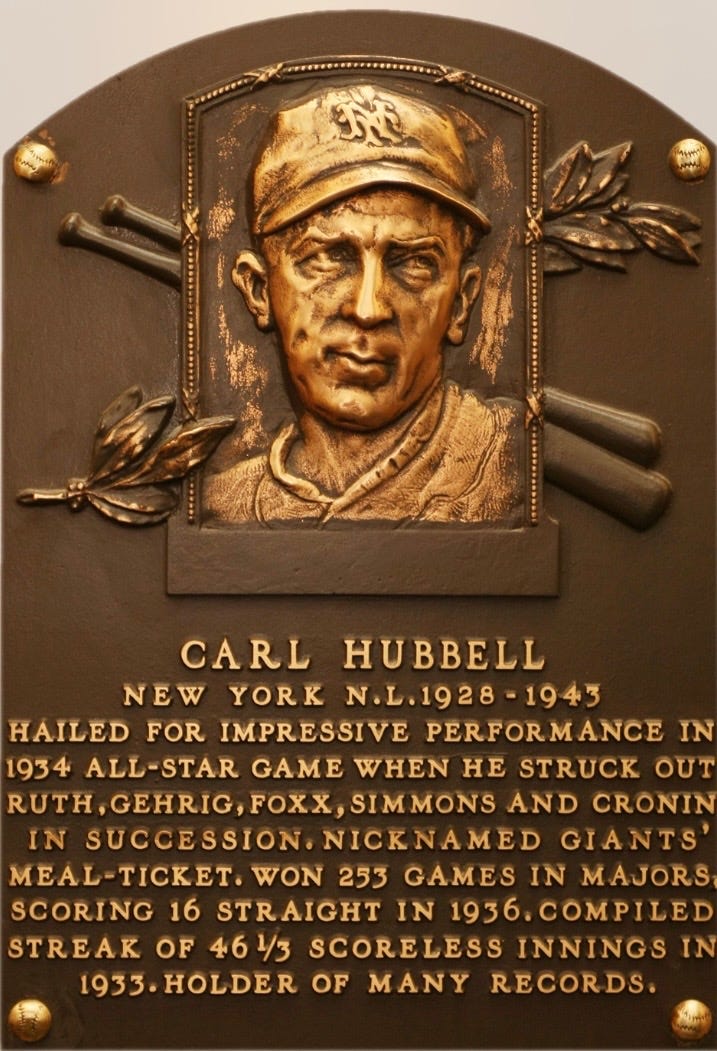
Yet that remarkable performance tells only a small part of his story.
Carl Hubbell wasn’t a pitcher who built his career around one magical afternoon.
He built one magical afternoon on top of a remarkable career.
By the time he retired after the 1943 season, Hubbell had won 253 games. The man known as the Giants’ “Meal Ticket” had led his club to three National League pennants and a World Series championship. He had earned two National League MVP Awards and, in 1936, became the first unanimous MVP in league history. He appeared in nine All-Star Games, more than any National League pitcher of his era, and was elected to the Hall of Fame in 1947.
Those achievements alone would have secured his place among baseball’s elite.
The five strikeouts simply gave him a signature moment.
In ensuing years, the pitch that made Hubbell famous would slowly disappear from the game.
For decades, the screwball was viewed with suspicion.
Some believed it placed too much strain on the arm, and many coaches eventually stopped teaching it. As the years passed, fewer young pitchers learned how to throw one, and eventually the pitch became almost as rare as the spitball or the eephus.
Even Hubbell had mixed feelings about his signature pitch.
Late in life, he acknowledged that he wasn’t sure he would recommend the screwball to young pitchers, though he never blamed it outright for the elbow problems that shortened the final chapter of his career.
Modern analysts have raised another possibility.
Perhaps it wasn’t the pitch that did in King Carl.
Perhaps it was the workload.
Between 1929 and 1937, Hubbell averaged more than 280 innings a season, working more innings, making more starts and throwing the second-most complete games in the sport in that span. He completed games with astonishing regularity (193 complete games in 298 starts). He often pitched on one or two days’ rest because that’s what great pitchers were expected to do in the 1930s.
Today’s starters celebrate reaching 180 innings.
Hubbell often surpassed 300.
Maybe the screwball wasn’t the villain after all.
Maybe the pitch was simply guilty by association.
What never disappeared was Hubbell’s reputation.
For all the attention his famous All-Star performance receives, the people who knew him best rarely talked first about the strikeouts.
They talked about the man.
They remembered someone who never confused confidence with arrogance.
Someone who preferred hunting camps to banquet halls.
Someone who remained almost embarrassed by the attention his greatest performance received.
Years after the All-Star Game, Hubbell admitted it had been the greatest day of his baseball life.
Not because he had set out to make history.
Not because he had planned to strike out Babe Ruth or Lou Gehrig.
He hadn’t.
He had been trying to survive.
That’s one of the best parts of this story.
History often convinces us that legendary moments were somehow inevitable, as though great athletes knew exactly what they were about to accomplish.
Carl Hubbell knew no such thing.
He wasn’t thinking about Cooperstown or newspaper headlines.
He wasn’t trying to become part of a trivia question ninety years later.
He was simply trying to escape a jam after allowing a leadoff single and a walk.
Sometimes baseball’s greatest moments are born not from ambition but from necessity.
I’ve always found it fascinating that the legend grows larger with each passing decade.
When Hubbell struck out those five hitters, there wasn’t even a Hall of Fame.
Nobody watching from the Polo Grounds grandstand could possibly know that Ruth, Gehrig, Foxx, Simmons and Cronin would someday be remembered as one of the greatest collections of hitters ever assembled.
They simply knew they were watching baseball’s brightest stars of the moment.
Time did the rest.
Every home run Ruth slugged.
Every RBI Gehrig collected.
Every MVP Foxx won.
Every milestone Simmons and Cronin reached.
Each accomplishment made Hubbell’s afternoon seem even more extraordinary.
The inning never changed. Our perspective on it did.
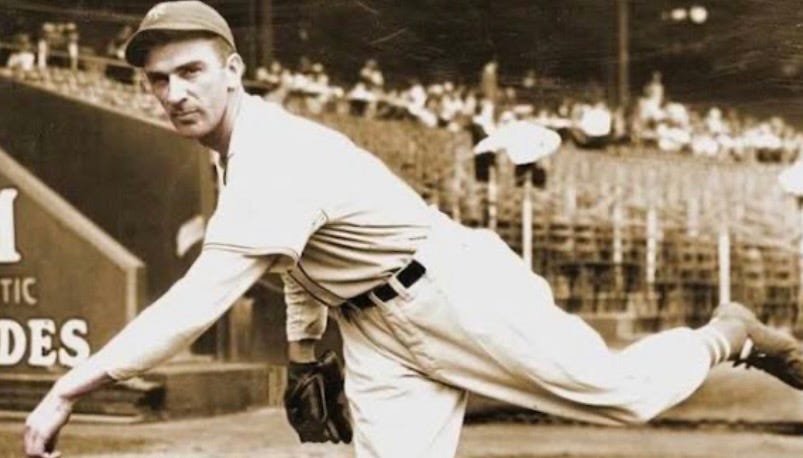
There’s another irony hidden inside the story.
The National League lost that day.
9-7.
If you ask even devoted baseball fans who won the 1934 All-Star Game, most couldn’t tell you.
Ask them what happened in the game...
That’s another matter entirely.
They remember Carl Hubbell.
History has a funny way of deciding what matters.
Every generation of baseball creates its own unforgettable performances.
Don Larsen’s perfect game.
Reggie’s three homers on three swings.
Kirk Gibson’s home run.
Jack Morris 10 innings in Game 7.
Madison Bumgarner’s bullpen masterpiece.
Shohei Ohtani strikeout of Mike Trout to end the World Baseball Classic.
Carl Hubbell belongs comfortably in that company.
Perhaps even above it.
Not because he struck out five future Hall of Famers.
Because he did it with one unusual pitch...
...the same pitch one of baseball’s greatest minds once told him to stop throwing.
Had Hubbell listened to Ty Cobb, the screwball might have disappeared into obscurity before most fans ever knew it existed.
Instead, it carried him all the way to Cooperstown.
It also gave baseball one of its most enduring images.
Babe Ruth walking away.
Lou Gehrig following him.
Jimmie Foxx next.
Then Al Simmons.
Then Joe Cronin.
Five legends.
Five strikeouts.
One quiet pitcher from Oklahoma standing alone on the mound, holding tightly to the one thing everyone else wanted him to let go.
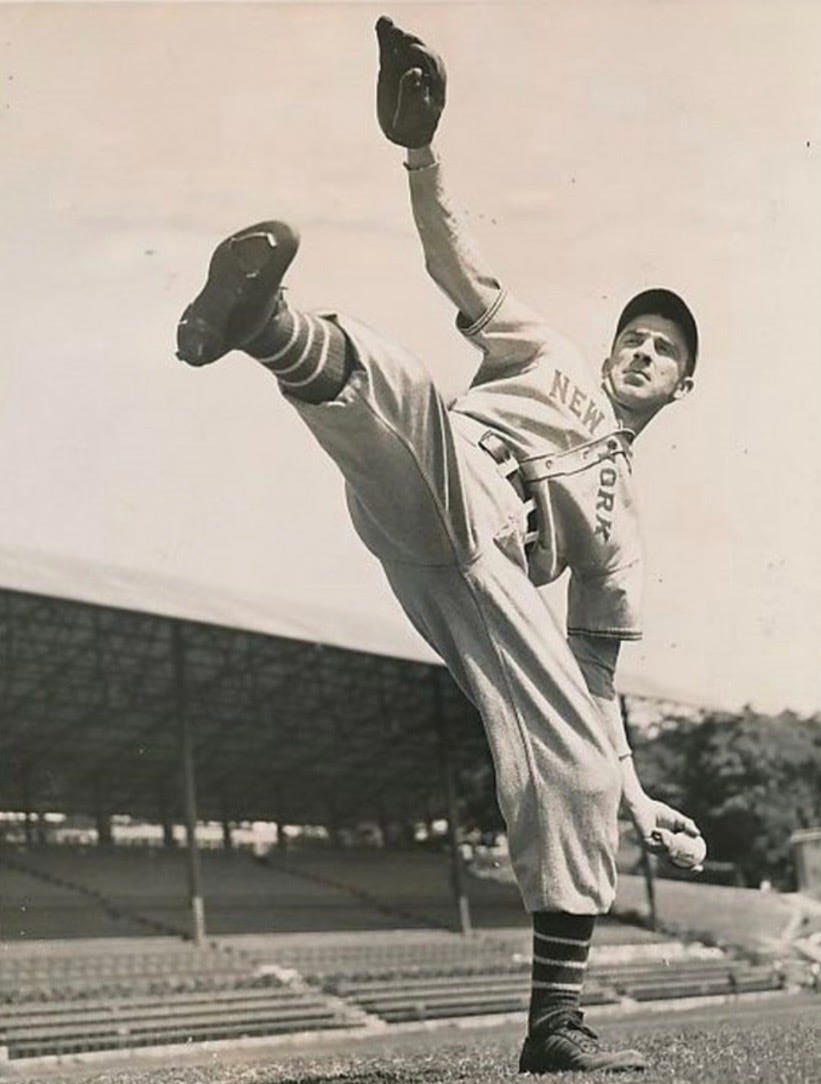
Enjoy the full NBC Radio broadcast of the 1934 All-Star Game with Tom Manning, Ford Bond and sportscasting pioneer Graham McNamee on the call.
While You’re Here…
Your feedback is always appreciated. Hit the “LIKE” button below if you enjoyed this post and please leave a comment.
Have a topic you’d like to see me write about in future editions of Extra Innings? Tweet me @GlennGeffner and use hashtag #ExtraInnings.
Learn more about one-on-one play-by-play coaching from Glenn Geffner via Zoom at GlennGeffner.com.
If you enjoy baseball stories like this one, you’ve come to the right place.
Extra Innings explores strange, fascinating and often forgotten chapters from baseball’s past--stories that live beyond the boxscore. With a subscription, new stories will be delivered directly to your email three times each week.
If you’d like to join our Extra Innings community, I hope you’ll consider subscribing. A monthly subscription is only $8. You can purchase an annual subscription that covers the 2026 season as well as occasional off-season posts and also gives you access to the full ever-green Extra Innings archive for only $80.
And if you enjoy our content, please share it with others who share our passion for baseball.