
Magic in the Moonlight
From a big league cup of coffee to big screen immortality, the story of the real Archibald Graham

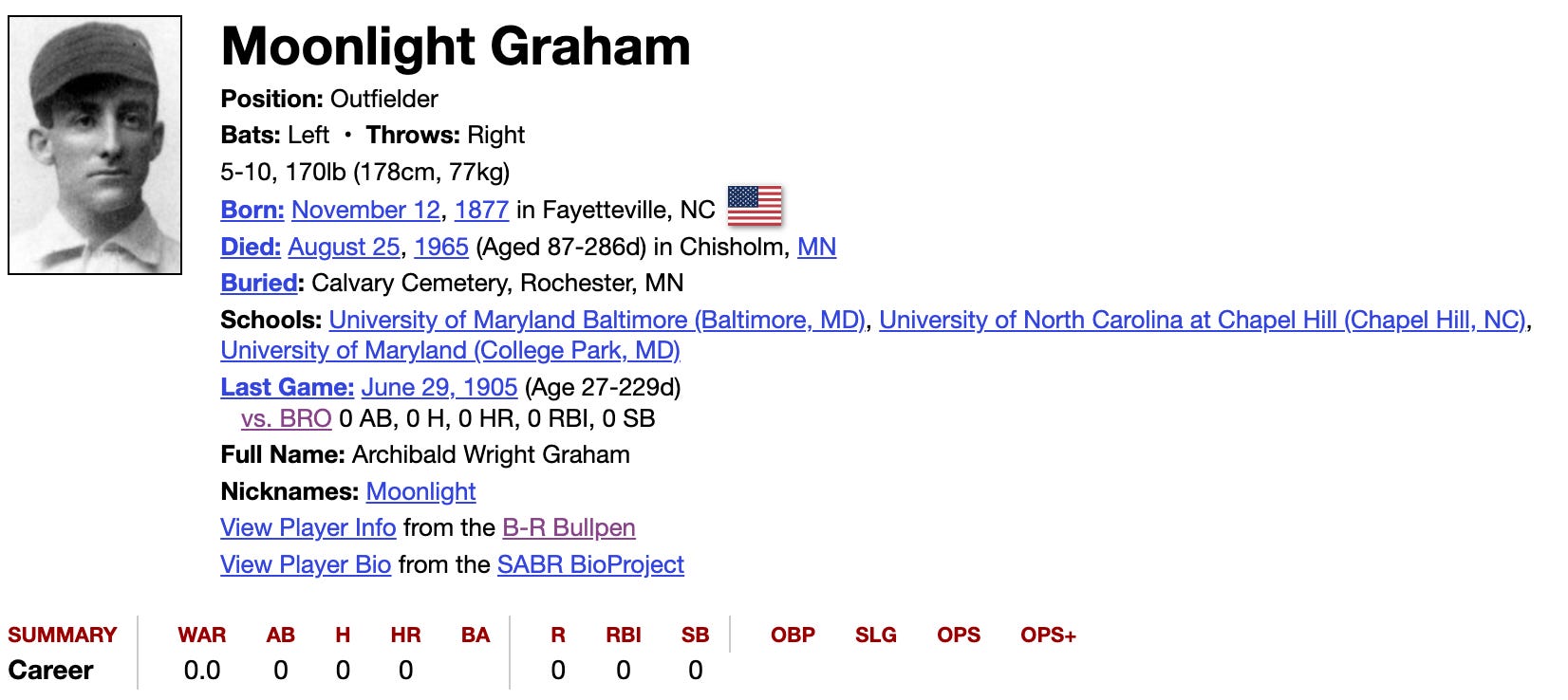
Have you heard the one about…
…the most famous ballplayer no one had ever heard of?
“It was like coming this close to your dreams and then watching them brush past you like strangers in a crowd.”
—Archibald “Moonlight” Graham in Field of Dreams
If not for the 1989 film classic Field of Dreams, Archibald “Moonlight” Graham surely would have remained little more than a forgotten line in The Baseball Encyclopedia.
He appeared in one major league game--121 years ago today, on June 29, 1905--then disappeared almost immediately afterward.
Yet nearly a century and a quarter later, he is one of the most recognizable unknown players in Baseball history.
It was a Thursday afternoon in 1905, and the National League-leading New York Giants were on their way to an 11-1 pounding of the Brooklyn Superbas.
The 27-year-old Graham played the final two innings in right field. No balls hit to him. No at-bat.
Nothing.
Even the boxscore did its best to forget Archibald Graham. One newspaper account published the following day, in the Springfield (Mass.) Republican, listed him not as “Graham,” but as “Braham”--a wrong letter attached to a blink-and-you-missed-it major league career.
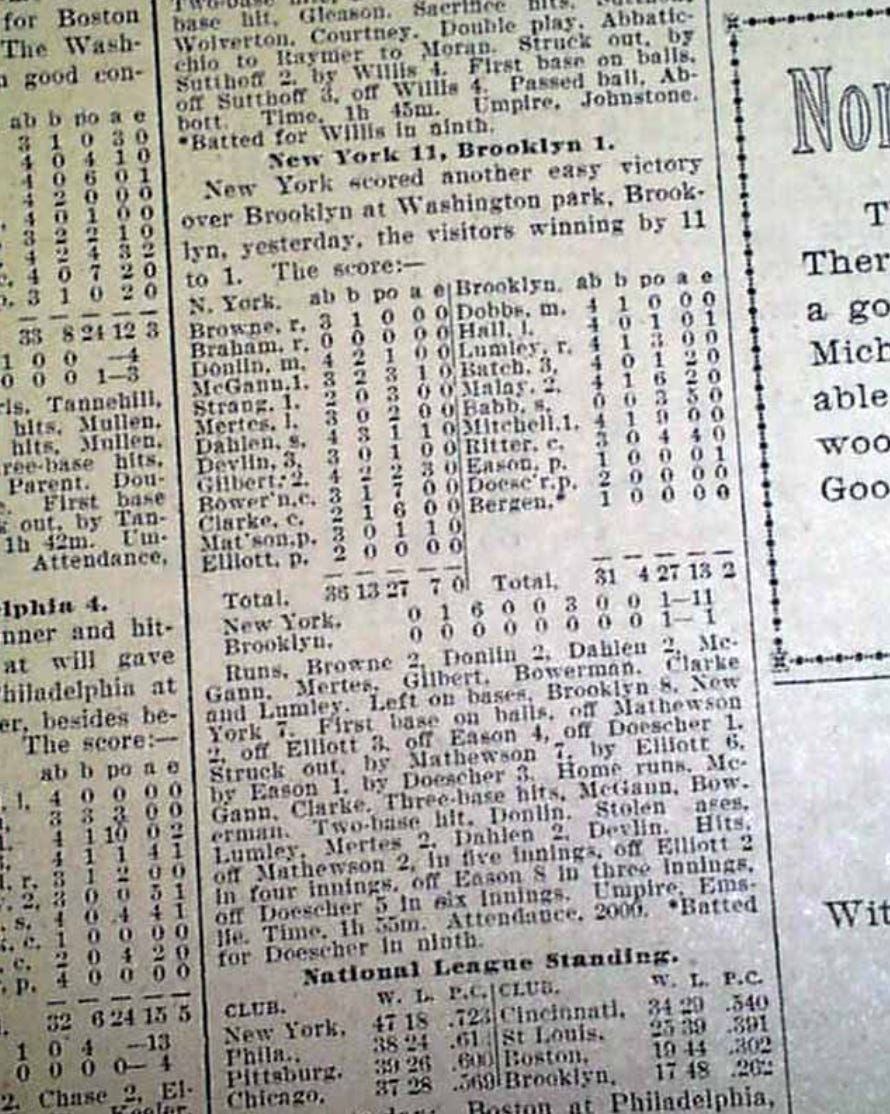
That feels strangely fitting. Because for decades, almost no Baseball fan knew Moonlight Graham anyway.
The real Graham was born in Fayetteville, N.C. in 1877. He was athletic, intelligent and ambitious. He played Baseball while studying medicine at the University of North Carolina, where he was also a member of the Dialectic Society, a debating organization.
It was in North Carolina that some suspect he picked up his colorful nickname, possibly from playing semi-pro games under the moonlight while he was pursuing his medical studies by day. Others have speculated he was known as “Moonlight” because he moonlighted at a second job in medicine in the offseason. There’s a third school of thought that the nickname stemmed from him being, as one writer put it, “fast as a flash.”
With great speed, a strong arm and a solid bat, he developed into a talented minor league outfielder--playing in places like Durham, N.C.; Portsmouth, Va.; Charlotte; Nashua, N.H.; Lowell, Mass.; Manchester, N.H.; Scranton, Pa.; and Binghamton, N.Y. between 1900 and 1905. Along the way, he caught the attention of legendary Giants manager John McGraw.
That meant a lot in that era.
McGraw’s Giants were one of the premier teams in Baseball in the early years of the 20th century. Led by Christy Mathewson, who was emerging as one of the greatest pitchers who ever lived, the Giants played an aggressive, hard-edged style that reflected their famously fiery manager, and they would go on to win the World Series in 1905.
And for one afternoon, Moonlight Graham was a part of it.
In the bottom of the eighth at Brooklyn’s Washington Park, with the Giants leading 10-0 after five shutout innings from Mathewson, McGraw sent Graham into right field to replace George Browne. With the game’s outcome already decided, Graham--who had ridden the Giants’ bench since joining the club May 13--took his position and waited.
And waited.
Strikeout…Fly ball to center…Strikeout. The Superbas went down 1-2-3.
The Giants batted again in the top of the ninth, and, with two outs, Graham was due to hit next--one baserunner away from coming to the plate in a big league game--when pitcher Claude Elliott popped to second for the final out of the inning.
He returned to the outfield for the bottom of the ninth. And while Brooklyn sent seven men to the plate and pushed across a run, not a single ball was hit Graham’s way.
He would never see the field again for the Giants.
Six days later, Graham was quietly sold to the Scranton Miners of the Class B New York State League, who had a working relationship with the Giants.
There was no final meeting with McGraw. No farewell. Just a young ballplayer sent packing.
Graham finished out the season, and ultimately his career, with Scranton, staying with the Miners through 1908 (except for a brief spell with the Memphis Egyptians for part of the 1906 season). He never again received a chance to step into the major league spotlight.
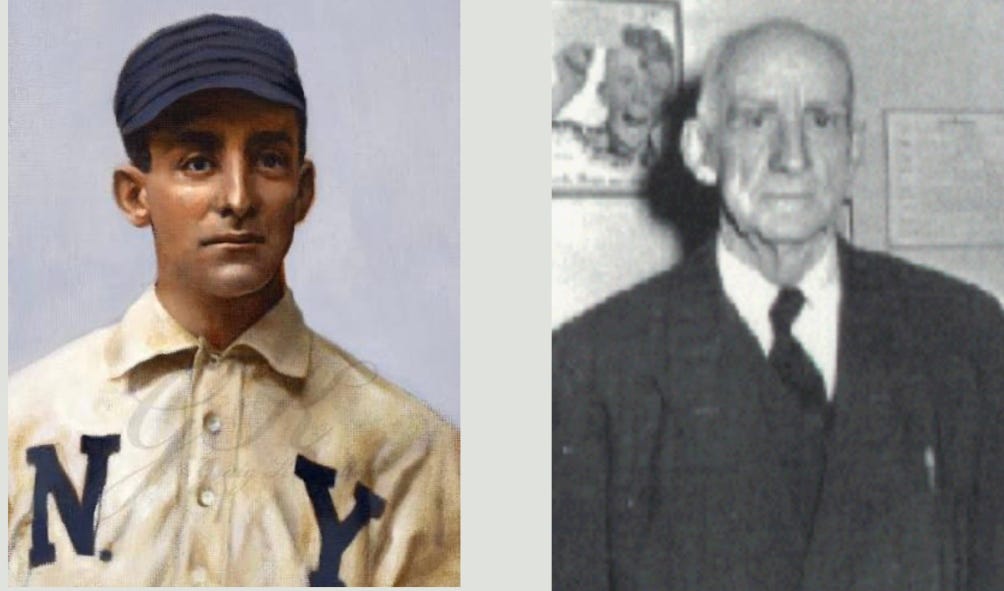
Field of Dreams famously portrayed Graham as a man who couldn’t help but wonder what might have been. That’s partly true, but the movie also turns him into something a little sadder and more tragic than the real man appears to have been.
Because the real Graham didn’t spend the rest of his life reliving those two innings.
When baseball ended, he devoted the rest of his life to medicine. As accurately depicted in the film, he settled in Chisholm, Minn., where he spent five decades serving the Iron Range community as a physician.
And this is where the movie intersects perfectly with the real story.
In Chisholm, Moonlight Graham became “Doc” Graham--the small-town doctor who made house calls, treated miners and immigrant families, cared for schoolchildren and gave free medical care to people who couldn’t afford it. He was also known for buying eyeglasses for children in need.
After just two innings in the sunshine of Major League Baseball, Graham spent 50 years making lives better in a small town in northeast Minnesota.
The movie changes plenty of details. Graham’s big league appearance is moved from 1905 to 1922. The circumstances surrounding his career are altered. Burt Lancaster’s elderly Doc Graham is portrayed as dying in 1972, while the real Graham actually passed away in 1965 at age 87.
But emotionally, the story works because it taps into something deeply inherent in the mythology of Baseball.
The sport has always found a place for people whose statistical footprint barely exists but whose stories are worthy of living on.
Moonlight Graham never had an official at-bat. His entire major league statistical record consists of one game played and a long string of zeros.
That’s it.
And yet we remember him 121 years later.
Not because of numbers. Baseball has always been about more than the boxscore. It’s about memory. Imagination. Near misses. Almosts. The stories people continue to tell long after the final out.
The funny thing is that if Graham had come to bat that day in 1905 and lined a simple single into right field or popped up to the shortstop, he never would have become famous at all. He would have blended into the endless sea of obscure early-1900s ballplayers who briefly passed through the major leagues and disappeared into history.
Instead, his lack of a moment became what he would be known for.
The almost became the story.
Because in Baseball, even an almost can live forever.
“If I’d only gotten to be a doctor for five minutes… now that would have been a tragedy.”
—Archibald “Doc” Graham in Field of Dreams
While You’re Here…
Your feedback is always appreciated. Hit the “LIKE” button below if you enjoyed this post and please leave a comment.
Have a topic you’d like to see me write about in future editions of Extra Innings? Tweet me @GlennGeffner and use hashtag #ExtraInnings.
Learn more about one-on-one play-by-play coaching from Glenn Geffner via Zoom at GlennGeffner.com.
If you enjoy baseball stories like this one, you’ve come to the right place.
Extra Innings explores strange, fascinating and often forgotten occurrences from baseball’s past--stories that live beyond the boxscore. With a subscription, new stories will be delivered directly to your email three times each week.
If you’d like to join our Extra Innings community, I hope you’ll consider subscribing. A monthly subscription is only $8. You can purchase an annual subscription that covers the 2026 season and occasional off-season posts for $80.
And if you enjoy our content, please share it with others who share our passion for baseball.

GG! Its TC. I'm accidentally commenting from my "After Further Review" substack. This was outstanding! I want to subscribe as me, so please send me an invitation to tomcatlin37@gmail.com. Will that work?