Da-da...da-da-da-da-da
Music to our baseball-loving ears


Have you heard the one about…
…the British musician who made an indelible mark on America’s pastime?
If you grew up loving baseball in the 1970s and ‘80s, you know the music instantly.
Not the title. Not the composer.
But you know the beat.
Da-da…da-da-da-da-da...
Da-da...da-da-da-da.
Those first few notes hit and suddenly it’s 12:30 on Saturday afternoon. Baseball cards nearby. The family Zenith humming to life.
And then you heard that voice.
“Hello there, everybody. This is Mel Allen.”
Joe Garagiola and Tony Kubek were on deck, 30 minutes away from bringing us NBC’s can’t-miss Game of the Week.
But first, Allen continued: “And THIS…is This Week in Baseball.”
For a certain generation of baseball fans, “Jet Set” wasn’t merely a TV theme song.
It was the sound of childhood. The sound of anticipation.
The sound of baseball itself.
What’s funny is that millions of fans spent decades hearing it without ever knowing the name Mike Vickers.
And Vickers had one of the strangest resumes imaginable for someone who unexpectedly became a melodious footnote in baseball history.
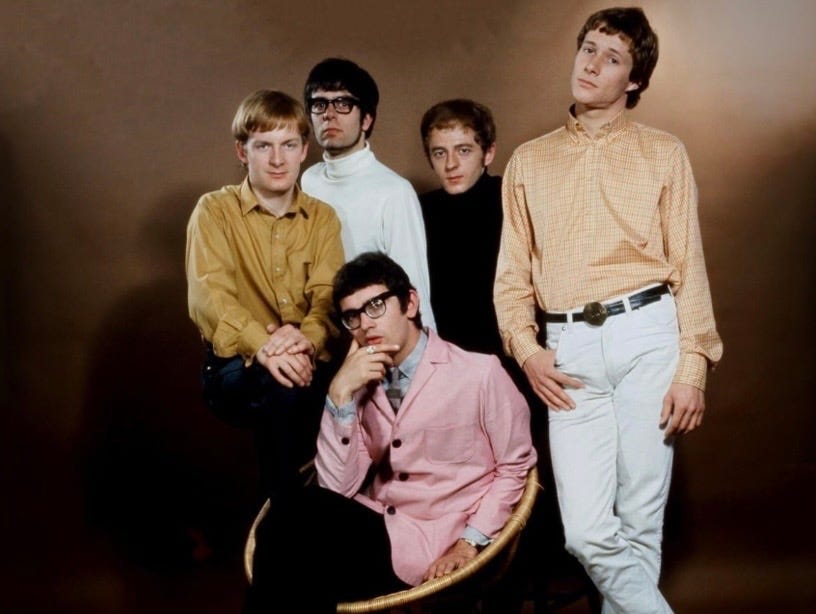
Long before composing “Jet Set,” Vickers was an original member of Manfred Mann (above), the British rock group best known for hits like “Do Wah Diddy Diddy” (which topped the charts in both the U.K. and the U.S. in 1964) and “Blinded by the Light.”
Originally a flute and saxophone player, Vickers shifted to guitar because bands suddenly needed guitarists as rock music evolved in the 1960s.
But woodwinds were always his true love. And you can hear that all over “Jet Set.”
The song sounds like a jazz orchestra sprinting through an airport terminal carrying Rawlings gloves and fungo bats.
Flutes dancing. Saxophones punching through. Trumpets blaring. Trombones sliding. Piano bouncing. Guitar chugging underneath it all.
“Jet Set” moves.
Over the years, fans have recreated full jazz-band arrangements featuring alto, tenor and baritone saxophones, flute, trumpet, trombone, piano, guitar, bass and drums because the arrangement itself became almost as beloved as the show it introduced.
And maybe that’s why it worked so perfectly with baseball.
Because baseball on television once had a purity about it.
Less argument. Less noise.
It was just…BASEBALL.
This Week in Baseball didn’t present baseball as something to debate all day on television panels or dissect through hot takes and engagement farming. There was no talk of WAR and VORP and spin rate.
It presented baseball as something you could fall in love with.
The show made the sport feel big, colorful and important. And the music did much of that work before Mel Allen spoke a word or Rod Carew cued a line drive over the shortstop’s head.
This really mattered because there was once a time--hard as it is to imagine today--when baseball highlights were actually difficult to find.
When This Week in Baseball premiered on April 1, 1977, there was no ESPN or MLB Network. The internet was many years away. No YouTube. No social media clips popping up on your iPhone 11 seconds after a home run landed in the seats.
There were only 2 nationally televised games per week during the regular season. And even if you lived in a major league city, not every game was televised. There was an expense associated with televising road games, and few home games were on TV because owners feared fans wouldn’t buy tickets if they could enjoy the game for free from their couch.
Some highlights might be available at the end of your 11 o’clock local newscast, but if your favorite team played 3 states away, you often had almost no access to seeing them at all.
That’s a big part of why This Week in Baseball became so important culturally.
The show didn’t simply present highlights.
It packaged baseball like folklore.
The bloopers. The slow-motion shots. The “TWIB Notes.” The freeze-frame graphics.
And the soaring music.
Ozzie Smith flipping through the air. Dave Parker throwing lasers from right field. George Brett exploding from his crouched stance and banging doubles to the gap in right-center.
Because of This Week in Baseball, a clip from an ordinary Tuesday night game felt epic by Saturday afternoon.
And floating above all of it was “Jet Set.”
The crazy thing?
The song wasn’t even originally written for baseball.
Before it became permanently attached to Mel Allen and baseball nostalgia, “Jet Set” was used in 1974 and 1975 as the theme music for Jackpot!, the NBC daytime game show hosted by Geoff Edwards.
Jackpot! contestants sat atop the “King or Queen of the Hill” podium while other contestants asked riddles from audience bleachers. Correct answers kept control. Wrong answers sent players rotating around the studio trying to build a growing jackpot.
Imagine hearing “Jet Set” over THAT.
The most iconic baseball theme music ever wasn’t even baseball music at all.
It was game-show music.
Technically, it was production-library music.
“Jet Set” originally lived on a British KPM music-library album--buried anonymously on Side B as Track 4 among a dozen instrumental compositions intended for television producers searching for background music.
One of the most emotionally powerful pieces of music in baseball history sat quietly on the B-side of a production-library record.
Waiting like an unknown 21-year-old in A-ball.
Nobody could have an inkling of what it would eventually become.
Nobody could know millions of fans would someday associate it with Saturday afternoons, baseball cards, Nolan Ryan highlights and dreams of becoming a big leaguer.
Nobody could know grown adults decades later would hear those opening brass notes and immediately feel something in their chest.
That’s the thing about nostalgia.
We often remember feelings before facts. Sounds before names. Emotions before identities.
Most fans never knew who the now 86-year-old Mike Vickers was.
But they knew--and still know to this day--exactly how his music made them feel.
And Vickers kept building his wonderfully eclectic career afterward.
He composed television themes including “Pegasus” for the cult British sci-fi comedy series The Adventures of Don Quick.
He arranged and conducted orchestral work during the golden age of British rock.
He collaborated with The Beatles, helping orchestrate “All You Need Is Love” for the band’s famous worldwide satellite television broadcast in 1967 and contributing synthesizer work during the Abbey Road era.
He worked with artists ranging from Eric Clapton and Dusty Springfield to orchestras and jazz ensembles.
He moved comfortably between jazz, rock, orchestral music and television production work.
Yet for millions of baseball fans, he unknowingly became the composer of their childhood.
Because “Jet Set” wasn’t just music.
It was the emotional signal that baseball was about to begin.
And maybe that’s why it still hits people so hard today.
Not because the melody itself is particularly complicated. Not because the arrangement was revolutionary.
Because it became attached to a feeling.
The feeling of racing to the television before the show started.
The feeling of discovering players and ballparks from across the major leagues.
The feeling of baseball seeming so important to our culture.
The feeling of being young.
Mike Vickers achieved something most composers never do.
He wrote something people didn’t merely hear.
He wrote a piece of music that will live for generations because it became the soundtrack to baseball fandom for millions.
If you have 21:37, I’m confident that watching this full 1977 episode of This Week in Baseball will be a highlight of your day. And don’t miss “Gathering Crowds” at the end.
That’s a story for another day.
While You’re Here…
Your feedback is always appreciated. Hit the “LIKE” button below if you enjoyed this post and please leave a comment.
Have a topic you’d like to see me write about in future editions of Extra Innings? Tweet me @GlennGeffner and use hashtag #ExtraInnings.
Learn more about one-on-one play-by-play coaching from Glenn Geffner via Zoom at GlennGeffner.com.
If you enjoy baseball stories like this one, there are plenty more to come.
Extra Innings explores strange, fascinating and often forgotten occurrences from baseball’s past--stories that live beyond the boxscore. With a subscription, new stories will be delivered directly to your email three times each week, with one free post every Monday (at least to get started) and subscriber-only stories every Wednesday and Friday.
If you’d like to join our Extra Innings community, I hope you’ll consider subscribing. A monthly subscription is only $8. You can purchase an annual subscription that covers the 2026 season and occasional off-season posts for $80.
And if you enjoy our content, please share it with others who share our passion for baseball.